The Alberta All-Season Resorts Act
Enabling Framework or Competitive Catch-Up?
Alberta has formally repositioned selected mountain assets as year-round economic platforms.
With the designation of Nakiska, Castle, and Fortress as All-Season Resort Areas, the Province has moved from passive land tenure administration to an integrated resort governance model.
This is not a marketing adjustment.
It is a structural regulatory shift.
The Act establishes authority.
The Regulation defines process.
The Policy guides discretion.
Together, they reduce ambiguity.
Reduced ambiguity lowers regulatory risk.
Lower risk attracts capital.
But clarity does not create performance.
Alberta’s Structural Position
Alberta’s ski ecosystem is significant. The province contains more than 30 ski areas, anchored by destinations such as Lake Louise, Sunshine, Nakiska, Marmot Basin, and Castle.
Structural maturity, however, varies.
Most Alberta resorts remain winter-dominant assets with limited base-area density and constrained four-season activation.
The All-Season Resorts Act signals intent to move beyond lift-ticket economics toward integrated resort ecosystems.
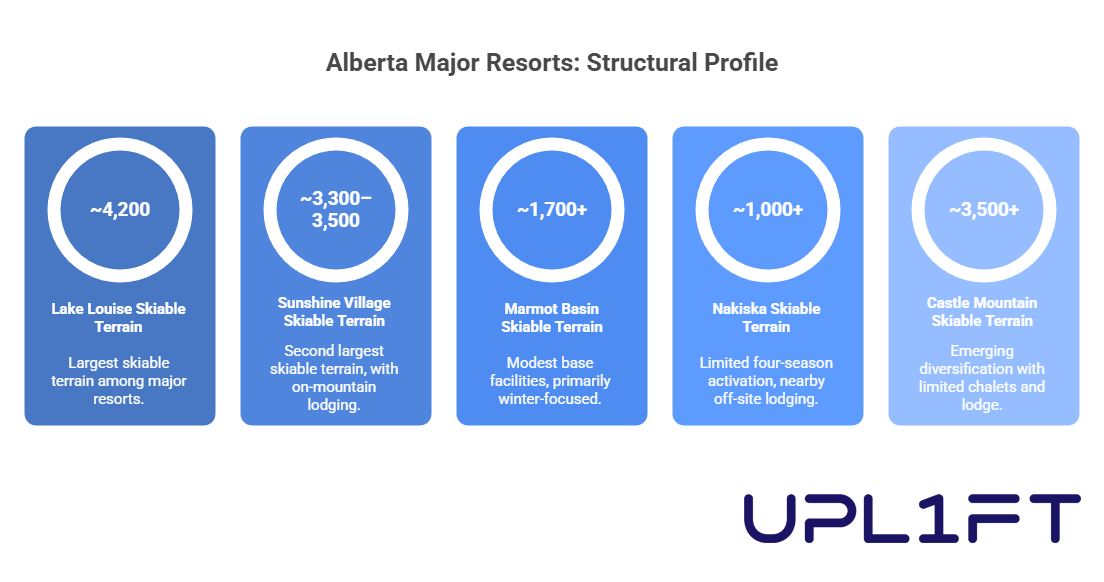
Alberta's major resorts show varied structural maturity, with skiable terrain and four-season activation being key differentiators (UPL1FT).
The opportunity now includes:
• Lift-served summer recreation
• Base-area mixed-use development
• Branded hospitality
• Wellness and spa facilities
• Conference and event infrastructure
• Residential integration
The policy door is open.
Delivery discipline will determine outcome.
What the Act Actually Changes
From a capital perspective, the framework delivers three material advantages:
1. Consolidated Authority
Fragmented inter-ministerial approvals are replaced with a resort-specific governance structure.
2. Designated Resort Areas
Formal designation improves land certainty and underwriting confidence.
3. Master Development Planning
Long-horizon planning instruments reduce regulatory volatility.
For institutional investors and private capital, predictability matters.
Alberta has improved predictability.
What the Act Does Not Change
The legislation does not validate:
• Absorption rates
• Product-market alignment
• Pricing durability
• Workforce housing adequacy
• Infrastructure sequencing
• Capital stack resilience
• Seasonality mitigation
Those variables remain market-driven.
North American precedent demonstrates a consistent pattern:
Real estate accelerates only when infrastructure, placemaking, and activation lead inventory.
Not follow it.
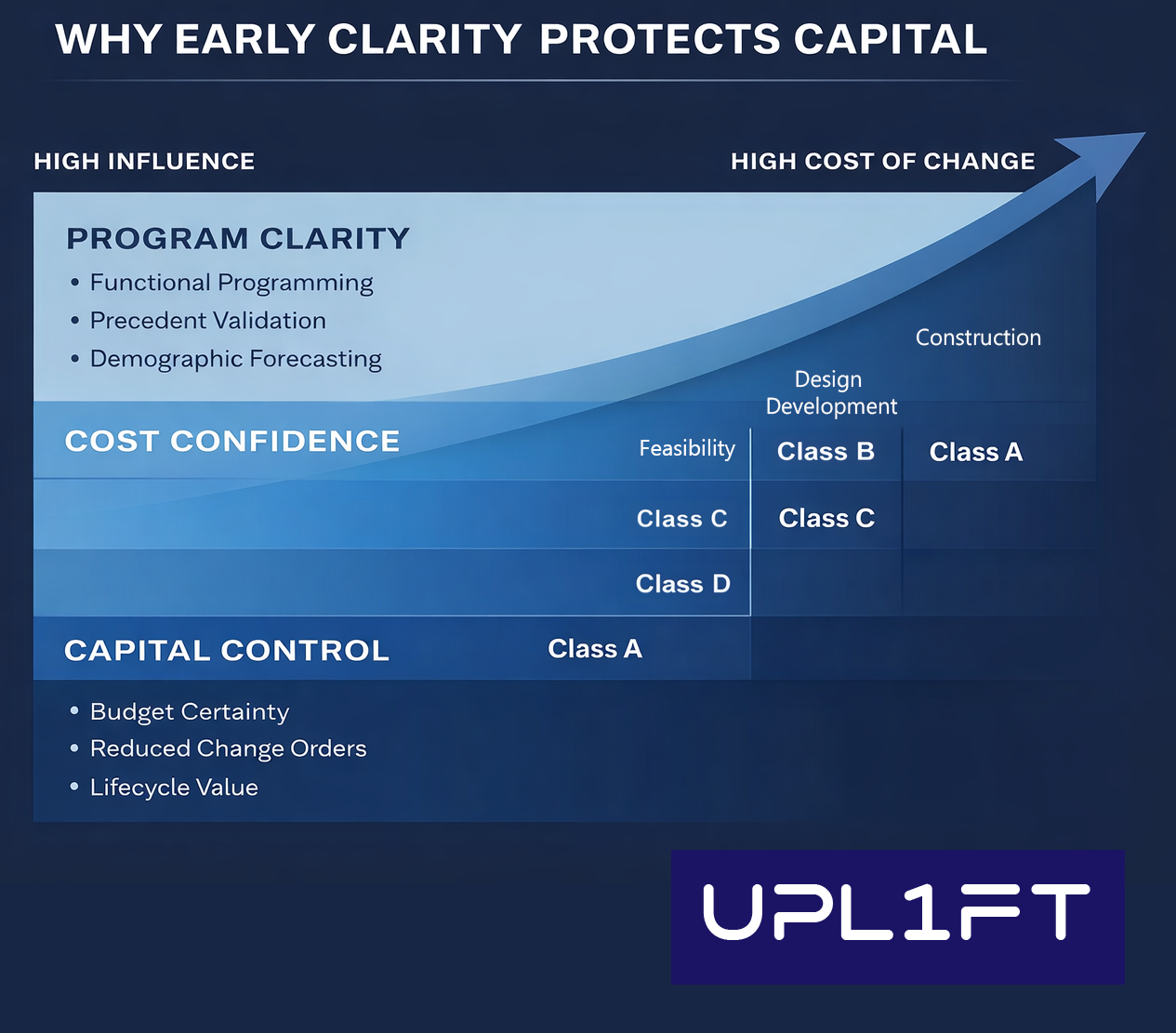
A structured visualization showing how early program clarity strengthens cost confidence and ultimately protects capital. Influence is highest at the beginning of a project and declines as resources are committed. Investing in early validation reduces downstream financial exposure (UPL1FT).
The British Columbia Benchmark
B.C. resorts have spent the last decade building structural competitive advantage through:
• Lift connectivity and terrain integration
• Activated pedestrian villages
• Wellness anchors
• Year-round programming
• Phased residential release
• Workforce housing integration
• Infrastructure-first sequencing
That advantage was not legislative.
It was operational.
British Columbia’s strength lies in activation depth and absorption discipline.
Alberta is now signaling intent to close that gap.
The Strategic Implication for Proponents
Regulatory clarity reduces friction.
It does not reduce complexity.
The All-Season Resorts framework accelerates the path from concept to submission.
Acceleration amplifies both opportunity and exposure.
The next cycle of Alberta resort development will be determined by:
• Capital structuring discipline
• Infrastructure-led phasing
• Conservative absorption modeling
• Amenity-first sequencing
• Workforce integration strategy
• Scenario-tested financial sensitivity
Projects that treat designation as momentum will compress margin.
Projects that treat designation as a decision threshold for structured validation will preserve pricing power.
This distinction is not architectural.
It is structural.
Where UPL1FT Operates
UPL1FT works at the intersection of:
• Governance interpretation
• Capital modeling
• Infrastructure sequencing
• Market absorption validation
• Risk sensitivity testing
The Alberta All-Season Resorts Act opens a policy runway.
The differentiator will be decision quality before capital is deployed.
Execution without structured validation increases exposure.
Validation before execution preserves optionality.
Policy creates permission.
Performance requires sequencing.