
Prepared for the City of White Rock.
Publicly released through Council reporting and municipal governance processes.

Civic Feasibility and Investment Readiness
(Community Hub - City Hall)
UPL1FT supported the City of White Rock in evaluating replacement of its 1962 City Hall and consolidation of municipal services into a modern, resilient civic facility.
A structured feasibility and capital readiness assessment informed Council decision making prior to design, procurement, and capital commitment. The study guided consultant procurement and next stage planning.
This assignment reflects UPL1FT’s role at the intersection of governance, finance, planning, and delivery, resolving scope, scale, phasing, and funding logic before downstream engagement.
The feasibility analysis was informed by a structured series of foundational studies prepared as standalone technical inputs.
Foundational Studies and Evidence Framework

Click each report cover to download the full PDF.
“Progressive building blocks, each one informing the next stage of analysis and establishing an evidence-based foundation for the HUBWRX feasibility phase”
Appendix Materials
Technical and Financial Foundations
The appendices established the technical and financial basis for the HUBWRX Feasibility Study.
They tested options, validated assumptions, and supported Council evaluation before advancing to design and procurement.
The analysis converted demographic, functional, site, and policy constraints into structured scenario comparisons used to assess feasibility, risk, phasing, and long-term value.
Evaluation Framework
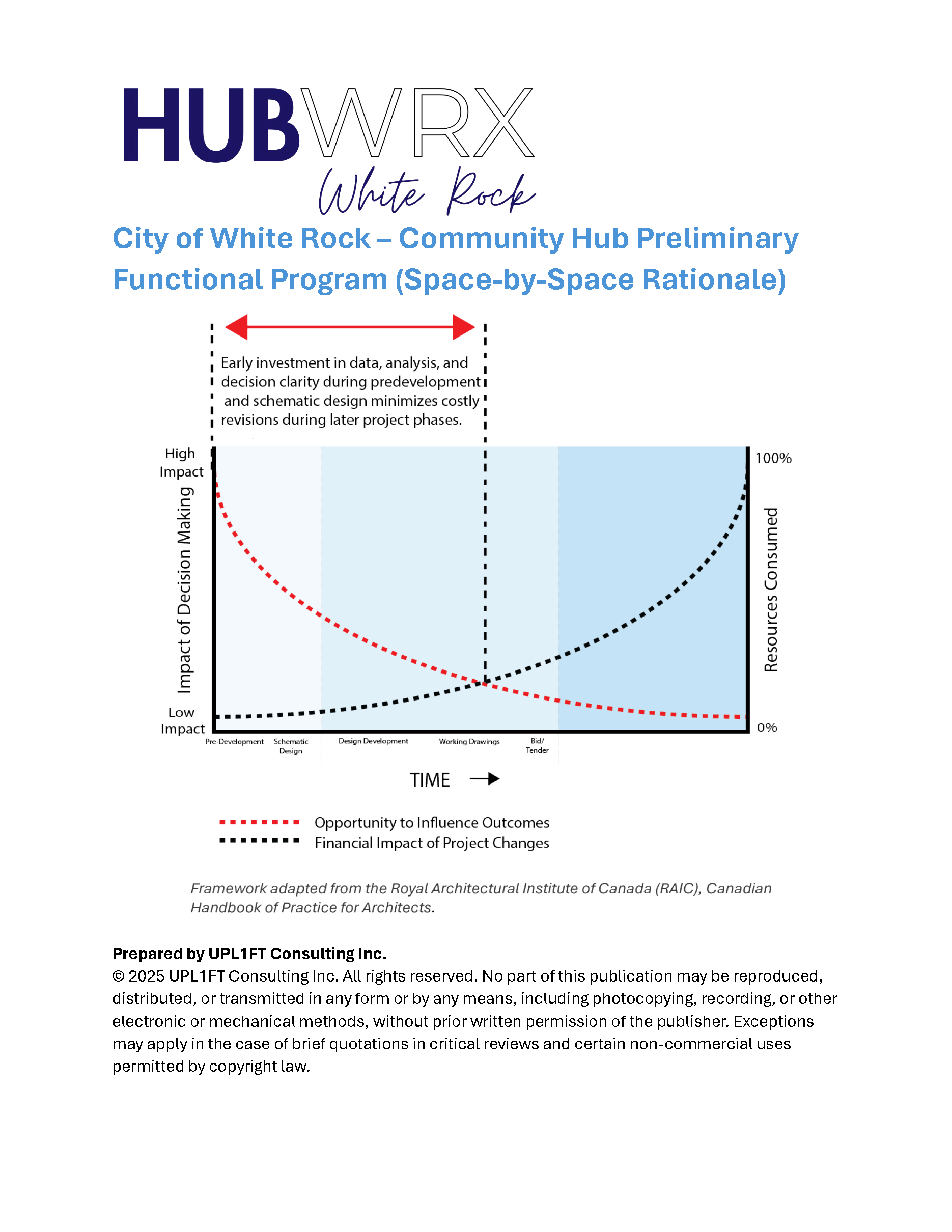
The images shown above are selected excerpts from publicly released appendices prepared for the City of White Rock as part of the HUBWRX feasibility process. They illustrate the methodology, evaluation logic, and spatial decision making applied to the study.
Analytical Rigor
The appendix materials show how the feasibility study was grounded in evidence, not preference. They demonstrate:
• How development scenarios were tested and compared
• How site capacity, massing, and phasing were evaluated
• How land use, parking, and servicing constraints were resolved
• How cost planning logic informed option viability without advancing detailed budgets
Together, these materials supported a transparent and defensible evaluation aligned with Council and provincial capital planning expectations.
From Feasibility to Implementation
The HUBWRX feasibility process integrated technical analysis with structured community and internal engagement. Public open houses, surveys, and cross-department workshops informed operational assumptions, space validation, growth planning, and scenario testing. Engagement findings were treated as evidence alongside demographic analysis, site evaluation, and cost planning.
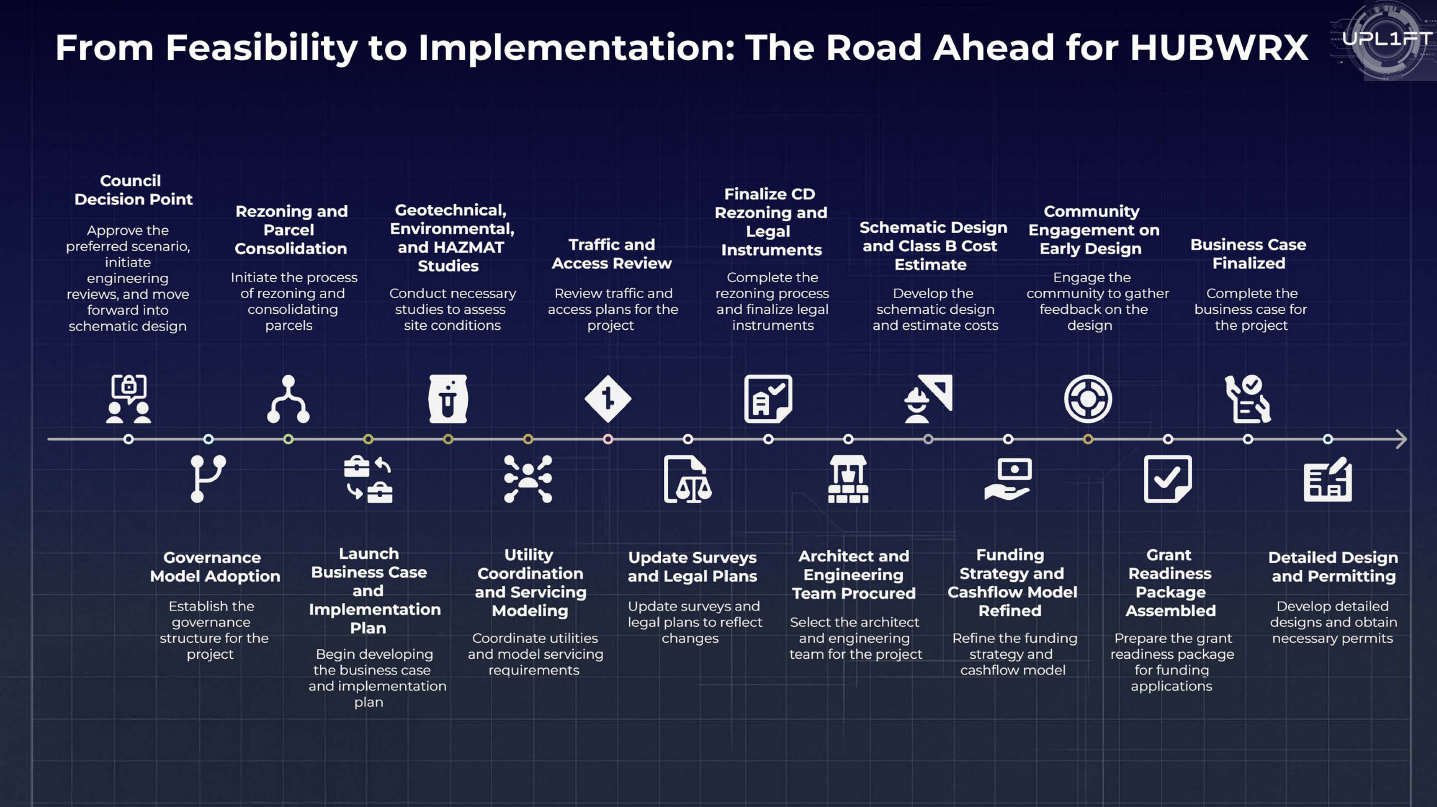
The timeline above outlines the progression from feasibility to implementation. It reflects a governance-led pathway aligning Council decision points, technical due diligence, and funding readiness before advancing into detailed design and permitting.
Early phases confirmed land use, site conditions, servicing requirements, and regulatory readiness. Later stages transition to schematic design, business case refinement, and coordinated funding strategy development.
This phased approach maintains transparency, fiscal discipline, and decision certainty as the project advances toward delivery.