From Uncertainty to Decision
UPL1FT Consulting helps public and private clients determine whether a project should proceed, under what structure, and with what level of capital exposure.
Feasibility is not a report. It is a disciplined decision process that protects capital, strengthens governance confidence, and positions projects for successful delivery.
Our role is to bring clarity before momentum overtakes judgment.
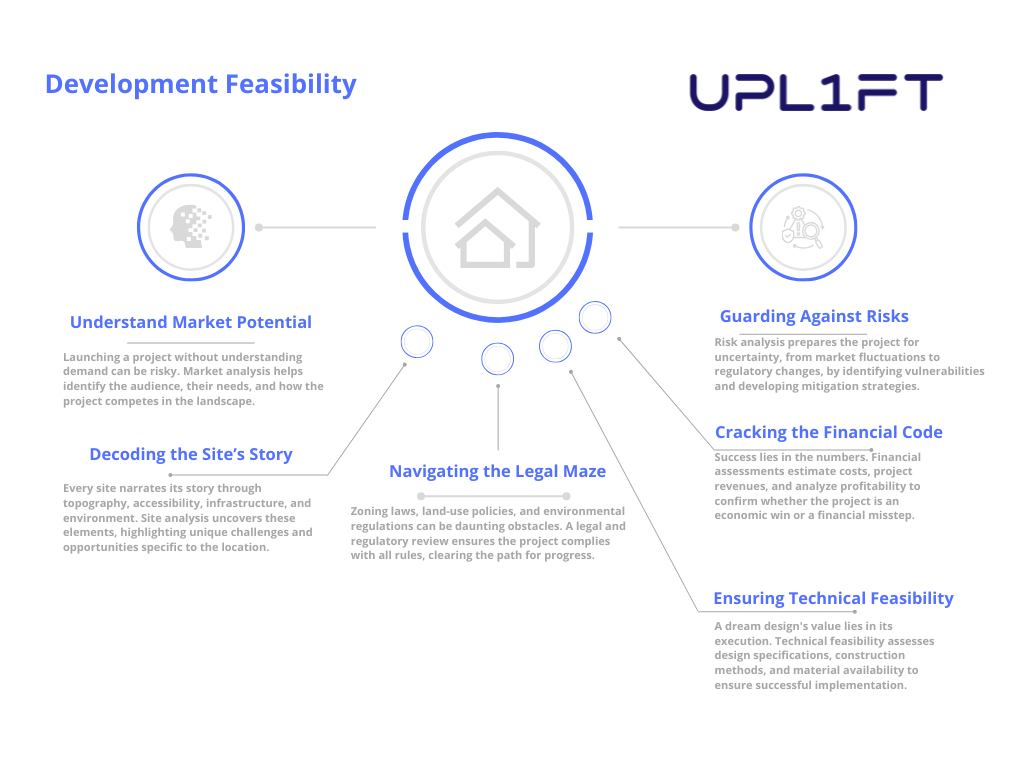
Development Feasibility Diagram (UPL1FT)
What We Actually Test
Every project is evaluated across 6 integrated decision lenses.
Market Viability
We quantify realistic demand, not aspirational demand. This includes Total Addressable Market, Serviceable Market capture, competitive supply, and demonstrated stakeholder need.
The question is simple. Is there durable demand at the scale being proposed?
Site and Entitlement Readiness
A concept must align with physical constraints, infrastructure capacity, and regulatory pathways. We assess constructability, approvals sequencing, and policy alignment to determine whether the project can move forward without disproportionate delay or risk.
Feasibility must survive real-world approvals.
Financial Resilience
We develop scenario-based financial models that test capital cost, operating exposure, revenue structure, and subsidy requirements.
Key outputs include:
Break-even thresholds
Sensitivity to utilization and pricing
Operating subsidy exposure
Return expectations under conservative assumptions
If viability only works in an optimistic case, it is not viable.
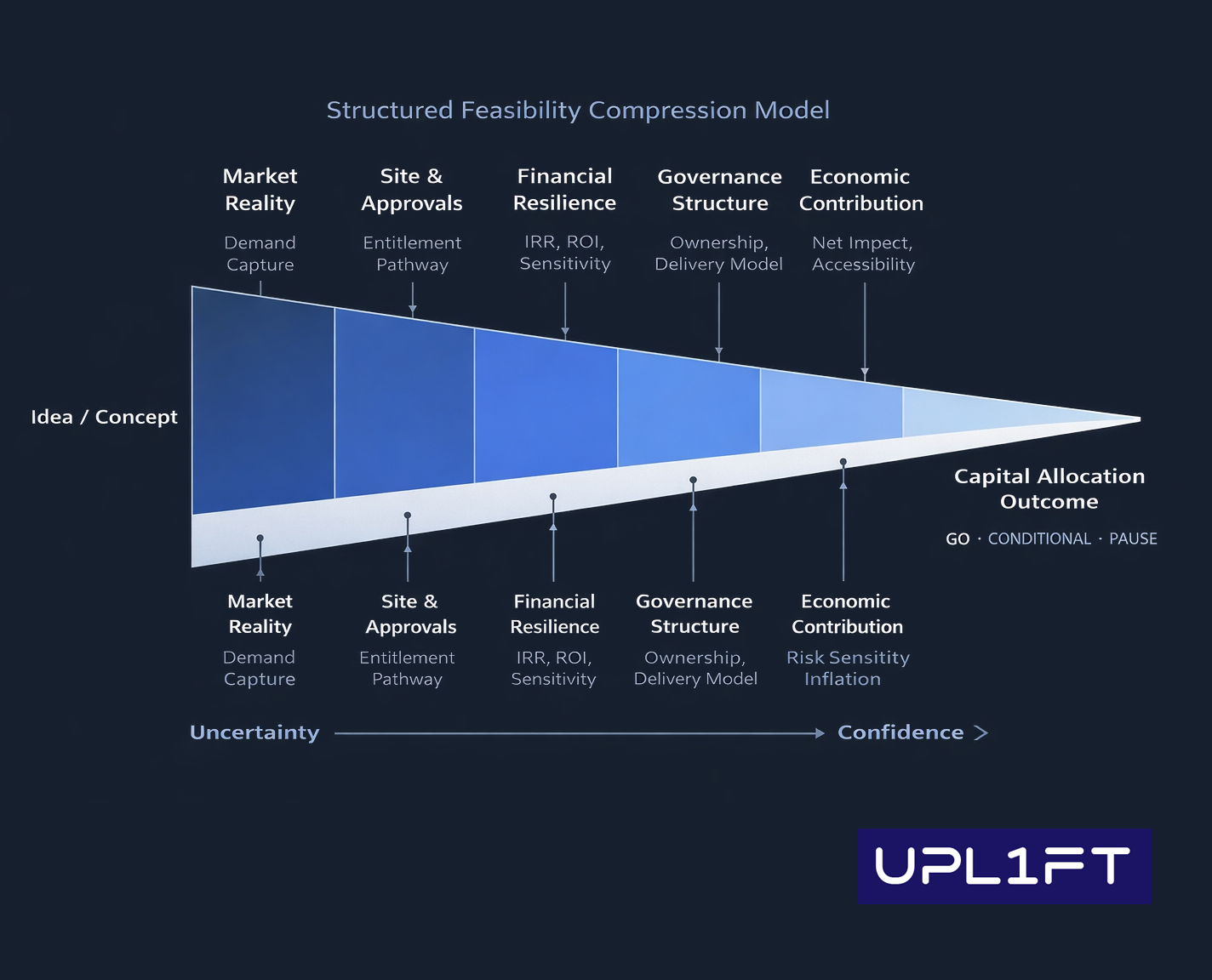
Structured Feasibility Compression Model (UPL1FT)
Governance and Delivery Structure
Ownership, management, and partnership models shape long-term success. We evaluate governance structures to ensure alignment with mission, accountability, funding eligibility, and operational sustainability.
Feasibility must be defensible at Council, Board, and investor tables.
Economic and Community Contribution
We assess measurable economic impact, affordability considerations, and accessibility outcomes. A project must generate broader value, not simply internal revenue.
Risk Exposure and Capital Discipline
We identify where the project is most exposed. Cost escalation. Demand variability. Regulatory delay. Funding uncertainty.
We then test whether those risks can be mitigated or whether scope, phasing, or structure should change.
Sometimes the correct recommendation is to proceed differently.
Sometimes it is to pause.
Both protect capital.
What Clients Receive
A clear go, no-go, or conditional proceed recommendation
Defined viability thresholds
Risk-adjusted financial scenarios
Governance-aligned conclusions
A phased pathway toward procurement and implementation
Outputs are structured to support funding applications, Council approvals, partnership discussions, and next-stage design decisions.
Why This Matters
Most projects do not fail because opportunity is absent. They fail because uncertainty was not resolved early enough.
UPL1FT integrates market reality, financial modeling, governance structure, and delivery logic into a single decision framework.
The result is not just feasibility.
It is strategic clarity that allows leaders to allocate capital confidently and move forward with conviction.
From uncertainty to decision.
With discipline.